

Hello and welcome to our website “sustainably travelling”.
We are students of the seventh class in a secondary school and we’ll like to inform you about sustainably travelling.
What is sustainably travelling?
What ist sustainably travelling? Do you know it? If not, it doesn´t matter. We will explaine it for you!
Sustainable travel means that our travel is not so negative for the environment and the future. It’s about making smarter choices that help mitigate the negative impacts of our travelling. We cannot control the CO2 emissions of the planes we fly in, the chemicals used by the hotels we stay in, or the plastics used in the souvenirs sold in the places we visit. But we can opt for more environmentally friendly means of transport, hotels, tour operators and shopping tactics that are less destructive to the environment and more beneficial to locals.
Why should we travel sustainably?
Travelling by plane or cruise ship is becoming more and more popular, but is not good for the environment.
Here is an example: On a flight from Munich to Frankfurt/Main a plane consume 227,4 kilogram CO2. Plans cause 5% of the global CO2 emissions. A Boing 747, for example, consumes about 470 litres of kerosene on the first 2 kilometres of the take-off. This is equal to a consumption of 23,500 litres per 100 km. This is 50 litres per passenger for a fully occupied aircraft.

Cruises in general are one of the most unsustainable ways to travel for a holiday. But they are becoming more and more popular as they become cheaper and more comfortable. When you take a cruise, pay attention to emissions and environmental impact. Search for cruise lines that use “scrubbers” to get clean emissions and ask them about their wastewater treatment and disposal guidelines. Unregulated cruise ships emit sulphuric acid, which acidifies the oceans. Some cruises, such as Discovery Voyage in Alaska, even offer a carbon offset program.
The 15 biggest cruise ships together cause as many emissions as 750 million cars a year.
What is the difficulty of sustainably travelling?
If you like to travel around the world, the best option is to travel by plane, because it is very fast and comfortable. Another plus is, that you can travel by plane to most of the cities and countrys of the world. It´s very easy and you will spend a lot of time.

The ticket for the fly is most cheaper than a ticket for the train for example.
What can we improve in the environment and the future?
What can we improve in the environment and the future? We can do a lot of thinks!
- Reducing flying
- Try to book non-stop flights whenever you can: It’s the takeoffs and landings that create most of an airplane’s carbon emissions.
- Travel more by bus or train
- If you have the time, traveling via bus, train, or ship generally has less negative environmental impact than traveling by plane.
- If you decide to drive to your destination and your car isn’t eco-friendly, consider renting a hybrid or electric vehicle, which use less fuel and produce less carbon emissions than gas-guzzlers.
- If you’re traveling with family or friends and the destination is within driving distance, maybe you should consider a car or bus trip. But if you’re traveling by yourself, it’s actually much more eco-friendly to fly!
- Do bike tours, hikings or boat tours
- Research weather conditions and terrain before you go hiking, biking or boating. You don’t want to be that guy (or girl) who got lost and required a ranger rescue, which drains public resources.



- Look for sustainability initiatives
- When traveling overseas, look for seals of approval from other certification programs, such as EarthCheck (Australia), Green Globe, Rainforest Alliance (Latin America, Caribbean), and Green Tourism Business Scheme (UK). Some countries, including Costa Rica, have their own certification programs to rate sustainability initiatives.

- Book eco-conscious accommodations
- Ask if the hotel has a recycling program. If not, encourage them to start one when you leave suggestions on comments cards at check-out.
- Ask questions about the hotel’s sustainability initiatives, such as solar power, wind turbines, rainwater harvesting, energy-efficient lighting, and low-flow toilets.
- When traveling in the U.S., check to see if the hotel has LEED Certification from the U.S. Green Building Council. The program judges hotels on sustainable site development, water savings, energy efficiency, material selection, indoor environmental quality, and innovation in design.
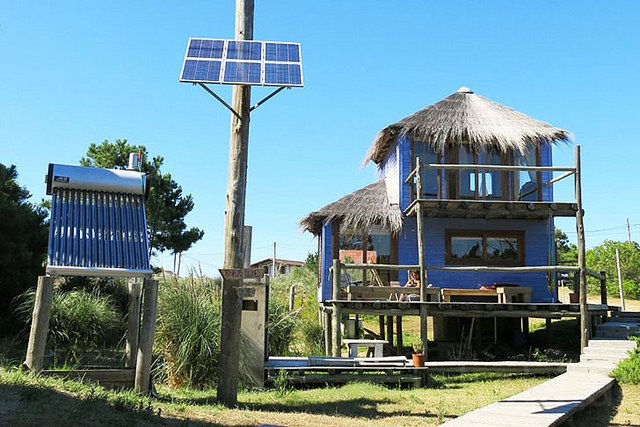
- Fly eco-friendly
- If you have to fly, consider doing so with one of the 30+ IATA (International Air Transport Association) member airlines who offer carbon offset programs to neutralize the aircraft’s carbon emissions by investing in carbon reduction projects.
- Reduce the use of natural resources
- Take showers, not baths. Showers use just 10-25 gallons of water, while baths use up to 70 gallons. Feeling frisky? Shower with a friend and save even more water!
- Try to take shorter showers, turning the water off while you lather up, shampoo, shave, and/or brush your teeth
- Reduce waste / plastic waste
- Never use the hotel laundry, as they typically wash every guest’s clothes separately (even when there are only a few items). We usually wash our clothes as we shower, then hang them up overnight so they’re dry the next day.
- Hang up your towels after each use, which is the universal sign that you’d like to use them again. You don’t wash your towels every day at home, so why do it when you travel?

- Leave a place better than you found it
- Bring a small bag along and pick up any trash you spot along your hike. Have a friendly competition to see who can clean up the most unsightly waste!
- Act like a local as best you can
- Never feed or touch wildlife, for any reason. Feeding animals makes them habituated to and reliant on humans, and often leads to attacks. If you get bit, the animal will most likely be killed.
- Choose your souvenirs wisely
- Don’t buy anything made from endangered plants/animals, unsustainable hardwoods, or ancient artifacts. Not only is it wrong, but you probably won’t be able to get them back through customs.
- Do not buy souvenir photos from anyone exploiting wildlife, such as the famous performing elephants of Thailand.
 sustainably travelling